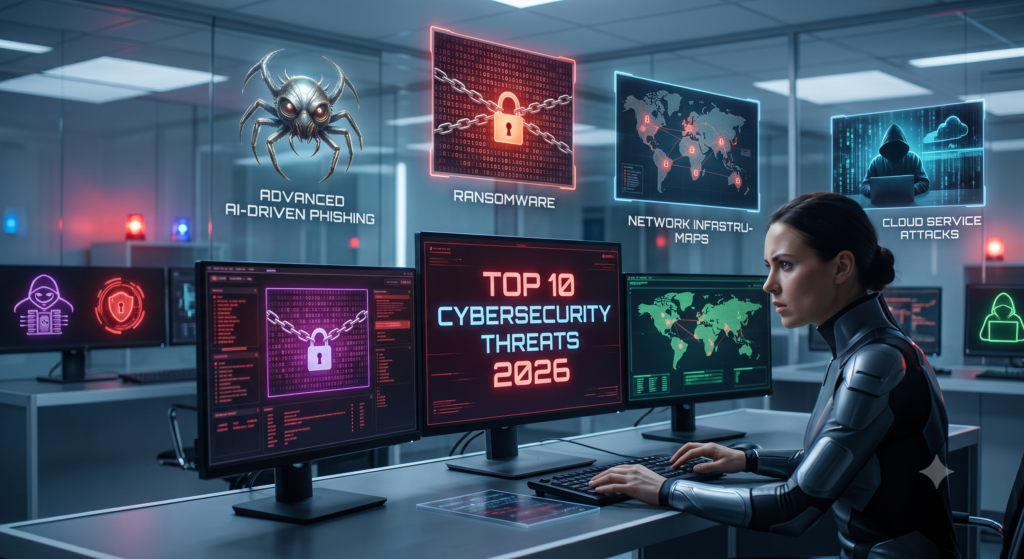
Cybersecurity threats 2026 are becoming more sophisticated and dangerous than ever before. Businesses of every size face risks from AI-powered attacks, ransomware, phishing, and data breaches. Understanding these threats is the first step toward protecting your organization.
Here are the top 10 cybersecurity threats every business must be aware of in 2026.
AI-powered cyberattacks are one of the biggest cybersecurity threats in 2026. Cybercriminals now use artificial intelligence to automate attacks and find vulnerabilities faster than ever.
1. AI-Powered Cyberattacks
Hackers are now using artificial intelligence to automate and supercharge their attacks.
AI allows cybercriminals to scan thousands of systems for vulnerabilities in seconds, craft
highly convincing phishing emails, and even adapt malware in real time to avoid detection.
Businesses must fight AI with AI — investing in AI-driven security tools that can detect
unusual patterns before damage is done.
2. Ransomware 2.0
Ransomware has evolved. In 2026, attackers don’t just encrypt your data — they steal it
first and threaten to publish it publicly if you don’t pay. This “double extortion” tactic
has become the new standard. Small and medium businesses are prime targets because they often
lack the security infrastructure of large corporations.
- Always maintain offline backups of critical data
- Train employees to recognize suspicious emails and links
- Invest in endpoint detection and response (EDR) tools
3. Phishing and Social Engineering
Phishing remains the number one entry point for cyberattacks. In 2026, attackers use
AI to create emails, voice calls, and even video messages that are nearly impossible to
distinguish from legitimate communication. Business Email Compromise (BEC) scams alone cost
companies billions annually. Regular employee training and multi-factor authentication (MFA)
are your best defenses.
4. Cloud Security Misconfigurations
As more businesses move to the cloud, misconfigured cloud settings have become one of
the leading causes of data breaches. A single incorrectly set permission can expose an
entire database to the public internet. Regular cloud security audits and proper access
management policies are essential for any business using AWS, Azure, or Google Cloud.
5. Supply Chain Attacks
Attackers have learned that targeting a large company directly is difficult — so they
target the smaller vendors and software providers those companies trust. In a supply chain
attack, malicious code is injected into a legitimate software update, infecting thousands
of businesses at once. Always vet your third-party vendors and monitor software updates
from external sources carefully.
6. Insider Threats
Not all threats come from outside your organization. Disgruntled employees, careless
staff, or compromised accounts pose a serious risk from within. Insider threats are
particularly dangerous because they bypass many external security measures. Implement
the principle of least privilege — employees should only have access to the data they
absolutely need to do their job.
7. IoT Device Vulnerabilities
The Internet of Things (IoT) has exploded in 2026 — from smart office devices to
security cameras and printers. Many of these devices have weak or default passwords and
receive infrequent security updates, making them easy entry points for hackers. Every
connected device in your office is a potential vulnerability. Segment your IoT devices
on a separate network and update their firmware regularly.
8. Zero-Day Exploits
A zero-day exploit targets a software vulnerability that the developer doesn’t yet
know about — meaning there’s no patch available. Cybercriminals and even nation-state
actors actively trade zero-day exploits on the dark web. While no business can fully
protect against unknown vulnerabilities, keeping all software updated and using
behavior-based threat detection significantly reduces your risk.
9. Deepfake Fraud
Deepfake technology has reached a level where audio and video of real people can be
fabricated convincingly. In 2026, cybercriminals are using deepfakes to impersonate
CEOs and executives, tricking employees into transferring funds or sharing sensitive
information. Establish clear verification protocols for any financial transaction or
data sharing request, regardless of who it appears to come from.
10. Quantum Computing Threats to Encryption
While still emerging, quantum computing poses a long-term threat to the encryption
methods that protect most of today’s sensitive data. Quantum computers will eventually
be able to break current encryption standards. Forward-thinking businesses are already
exploring quantum-resistant encryption methods to future-proof their security
infrastructure.
How to Protect Your Business in 2026
Cybersecurity is not a one-time investment — it’s an ongoing commitment. Here are
the foundational steps every business should take today:
- Enable multi-factor authentication (MFA) on all accounts and systems
- Train employees regularly on how to spot phishing and social engineering
- Back up data frequently and store copies offline or in a separate cloud environment
- Conduct regular security audits of your systems, cloud settings, and third-party vendors
- Have an incident response plan ready so your team knows exactly what to do if attacked
Final Thoughts
The cybersecurity landscape in 2026 is complex and constantly evolving. The businesses
that survive and thrive are those that treat security as a core part of their operations —
not an afterthought. Start with the basics, stay informed, and never assume your business
is too small to be a target. Because in the eyes of a cybercriminal, every business is
an opportunity.