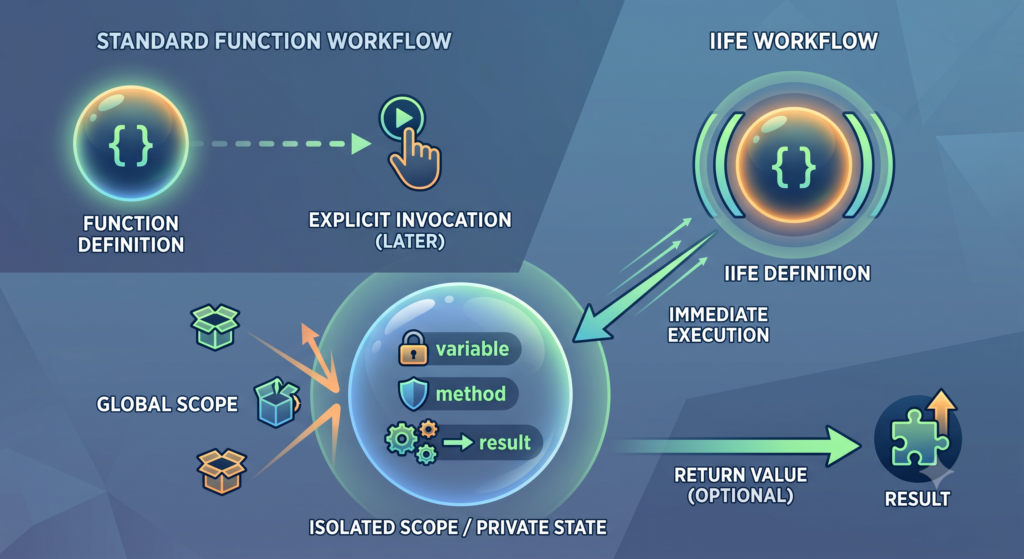
An Immediately Invoked Function Expression (IIFE) is a fundamental JavaScript design pattern consisting of a function that runs automatically the exact moment it is defined. Historically, JavaScript only had function scope and global scope (prior to the introduction of block-scoped let and const variables in ES6 version). Because of this, developers needed a reliable way to create a local, private scope to ensure their variables did not accidentally leak out and pollute the global namespace.
By wrapping a function’s declaration inside a set of standard parentheses (function() { ... }), you are explicitly instructing the JavaScript parsing engine to treat that block of code as an expression rather than a standard function declaration. Once the engine evaluates it as an expression, the trailing set of parentheses () instantly executes it. Any variables, arrays, or objects declared inside that IIFE are essentially trapped in a closure, completely invisible and inaccessible to the outside global environment, preventing naming collisions in complex web applications.
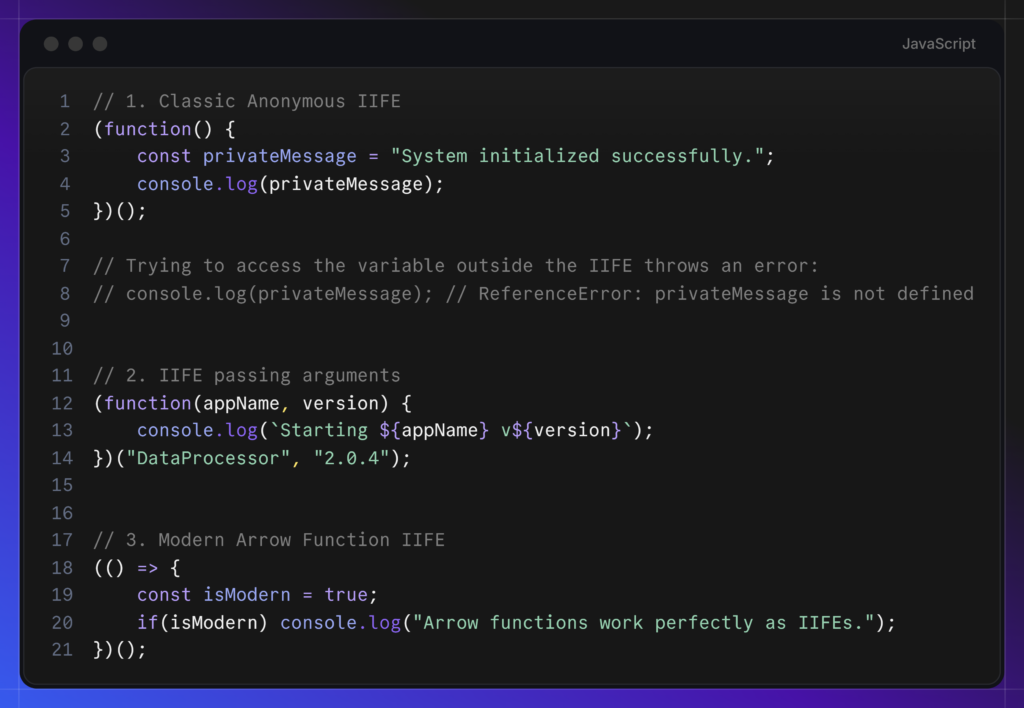
Breakdown
- Classic IIFE: The first set of enclosing parentheses converts the inner code into a function expression. Without these wrapping parentheses, the JavaScript engine would throw a
SyntaxError, as it expects standard function declarations to have a name. The second set of parentheses at the very end()acts as the invocation trigger. - Passing Arguments: You can pass variables into an IIFE just like any normal function. In the second example,
"DataProcessor"and"2.0.4"are passed into the trailing parentheses, which are then mapped to theappNameandversionparameters inside the isolated scope. - Arrow Functions: With modern ES6 syntax, IIFEs can be written more concisely using arrow functions, maintaining the exact same privacy benefits but with a cleaner visual footprint.
Real-World Use Case
The Module Pattern and Private State: Before modern JavaScript modules (import/export) became the native standard, IIFEs were the primary mechanism for the “Module Pattern.” If you are building a complex UI widget, a user tracking script, or a third-party library, you use an IIFE to wrap your entire codebase. This ensures that if the host website using your script already has global variables named config, init, or state, your script won’t overwrite them or cause unexpected application crashes.
Furthermore, IIFEs are heavily used to create closures that maintain private state. For example, if you need a counter variable that cannot be accidentally modified by other scripts on the page, you can use an IIFE to return an object with methods that interact with that private variable. The variable remains safely tucked away in the IIFE’s scope, accessible only via the specific methods you decide to expose.
Interview Question & Answer
Question: Can you explain the primary purpose of an Immediately Invoked Function Expression (IIFE) with example, and how the JavaScript engine differentiates it from a standard function declaration?
Answer: The core purpose of an IIFE is to establish immediate data privacy and prevent the pollution of the global namespace. It allows developers to execute setup logic or encapsulate state without leaving residual variables behind in the global environment.
The JavaScript engine differentiates it through syntax. If a statement starts with the function keyword, the engine expects a standard function declaration, which requires a name and is hoisted into memory to be called later. By wrapping the function keyword in parentheses (), we force the engine to parse the code as a function expression. Because it evaluates to an expression, we can immediately append () to the end of it, forcing the engine to execute the logic in a single, synchronous step. Once the IIFE finishes executing, its internal variables are garbage collected or locked in a closure, leaving the global scope completely clean.